


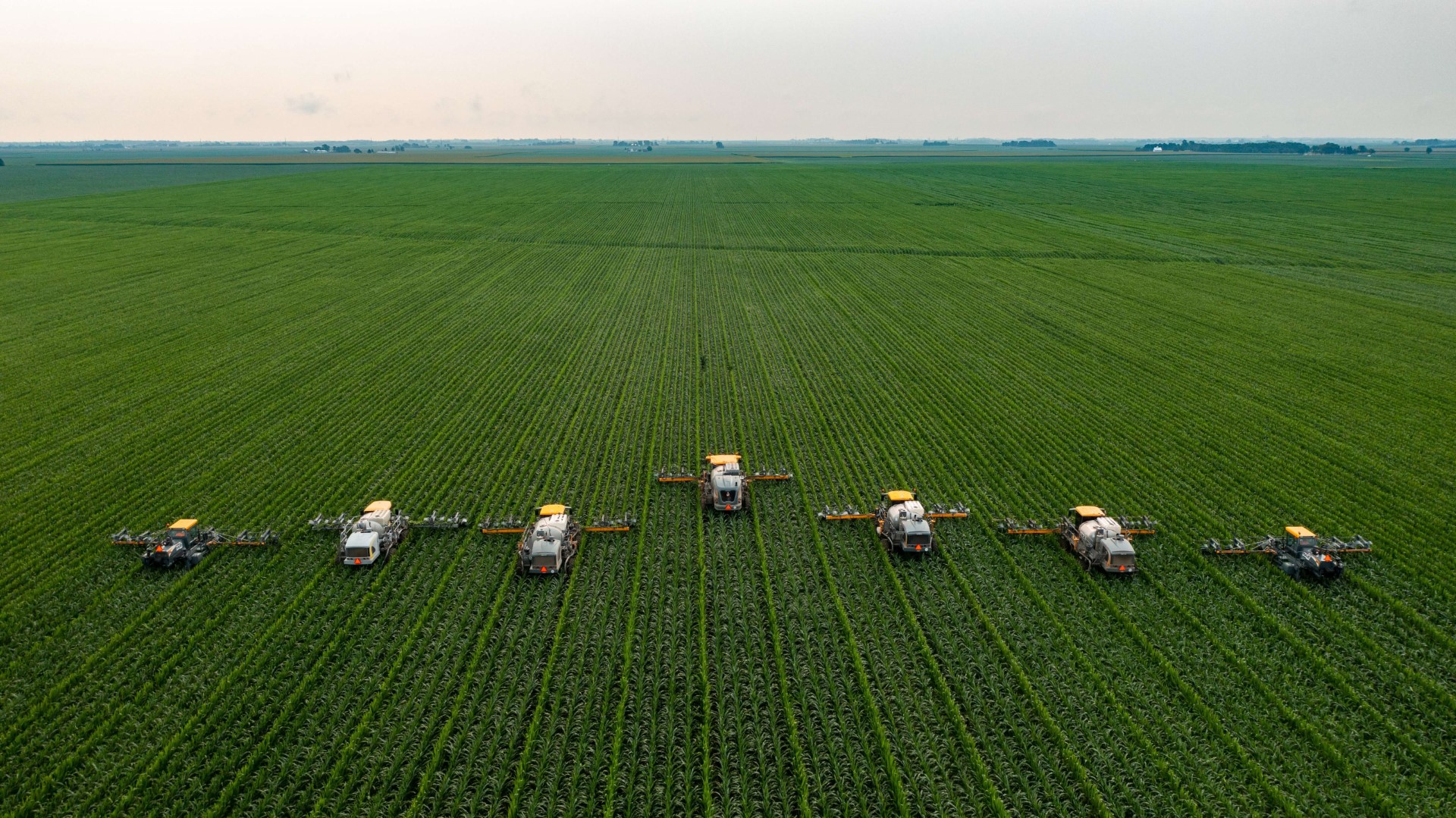
Late fertilisation – Tips and Ideas
For many years, it has been common practice, to apply most or all of your fertiliser fairly early, here in Denmark. For e.g. cereals, typically all of the fertiliser is applied by the end of April, and then it is just to wait until harvest – fertilisation wise.
But while such a strategy contains an ease of mind, with regards to getting things done, it also contains some serious risks of fertiliser loss due to leaching or evaporation, and it also means no possibilities to readjust the strategy if the weather becomes extreme, particularly in countries like Denmark, where we have strict nitrogen quotas.
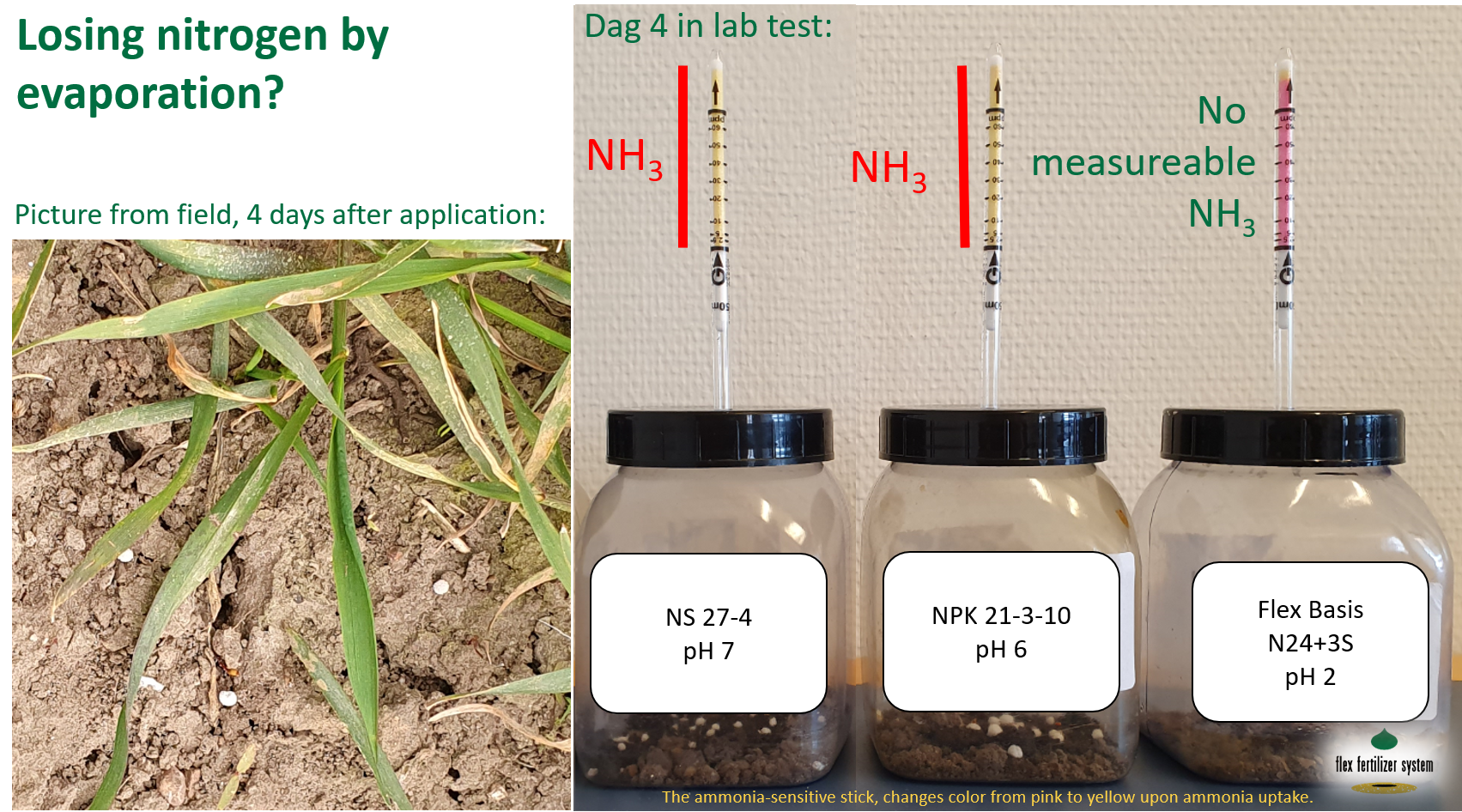 A major problem of late fertilisation, if you use granulate fertiliser, is the need for rain. Without 5-10 mm of rain at least, most of the fertiliser will just be sitting on the soil surface, and not doing much good other than evaporating (and yes, an ammonium-nitrate fertiliser also evaporates. This is not just a urea-issue!)
And then there is of course also the problem of nitrous oxide. The more nitrogen you apply to the soil, and the longer it sits there, before being taken up, the bigger the risk of nitrogen-oxide formation, and hence the bigger the climate-effect of the fertiliser.
No rain in sight: big problem! Or…?
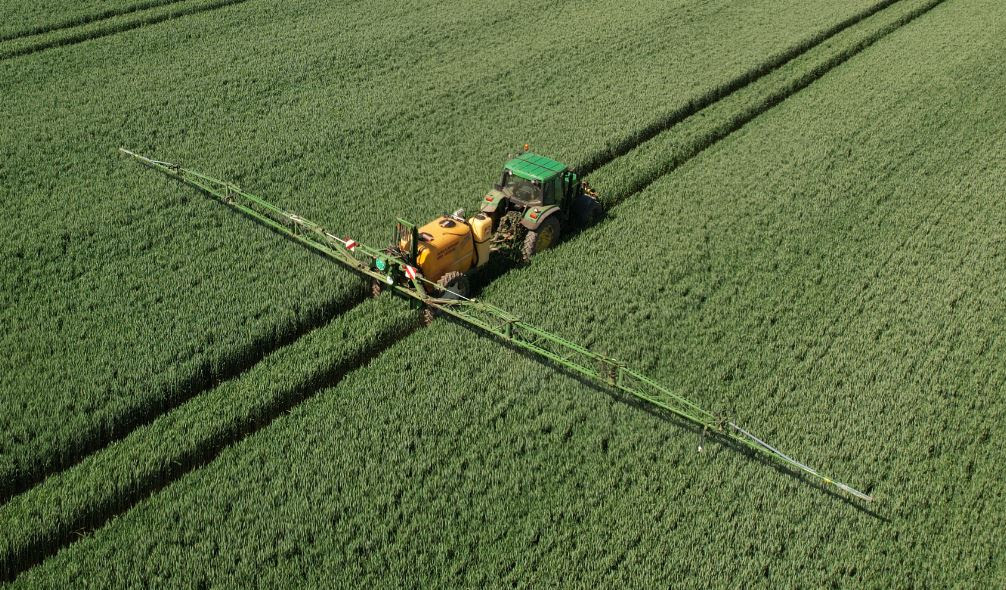 So instead, you should be looking into liquid fertilisers, in particularly true foliar fertilisers, as they are designed to be taken up via the leaf directly, without the need for any rain. And they work within hours, so if your crop is already deficient, it will start to react and growing faster, almost immediately.
Cereals
For cereals, a foliar application of 5-10 kg N per hectare is common use in many places, and tolerance is good. If you use a true foliar product, like Flex Foliar, the tolerance goes up, and in many cases you can apply as much as 20 kg N or more. Remember always to use a flat-spray-nozzle or a low-drift-nozzle – and to add an adjuvant to lover the surface tension. Particularly in cereals, the leaf is very hydrophobic, and most of the fertiliser will “bounce off” if you do not add a wetter/sticker like Agropol, Contact or similiar.
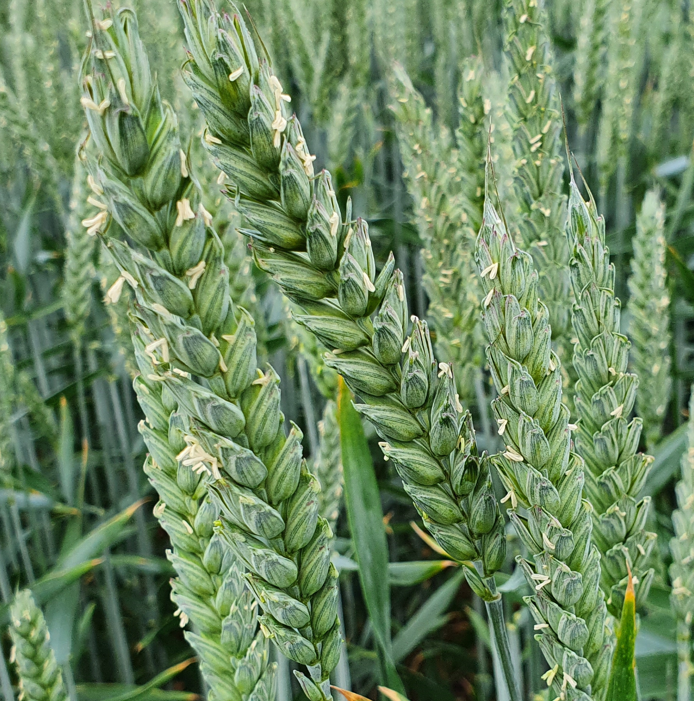 In cereals, you can apply foliar fertiliser until approx. 14 days after flowering. This is extremely late, compared to normal late-fertilisation schemes with granulates, that typically end around stage 59 before flowering, but because the foliar products work right away this gives you unique opportunities to keep the crop growing longer, and to bulk to its max.
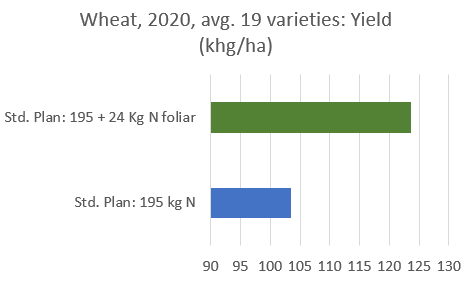 We have seen many nice yield boosts – perhaps one of the most interesting ones we saw in 2020 in a Winter Wheat test-field in Sealand. Here we added 24 kg N as Flex Foliar NPS 18-1-2+Mg around 10 days after flowering, and achieved a yield increase from around 10 to around 12 ton per hectare, and also a small protein-increase. Similarly in Winter Barley the same place, we saw a 600 hkg increase with 19 kg N.
Potatoes
In potato – particularly in starch potato – keeping the crop growing for as long as possible means extra bulking and more yield – hence more money in your pocket.
Here our Danish producer, BJ-Agro, has spent the last 7 years optimising the use of foliar fertilisers to keep the crop growing for as long as possible, particularly under difficult weather situations like drought-like conditions.
Even though most potato-farmers have the possibility to irrigate, it does not fully compensate for a good amount of rain, and we often see granulates placed at planting being only partially dissolved under such conditions.
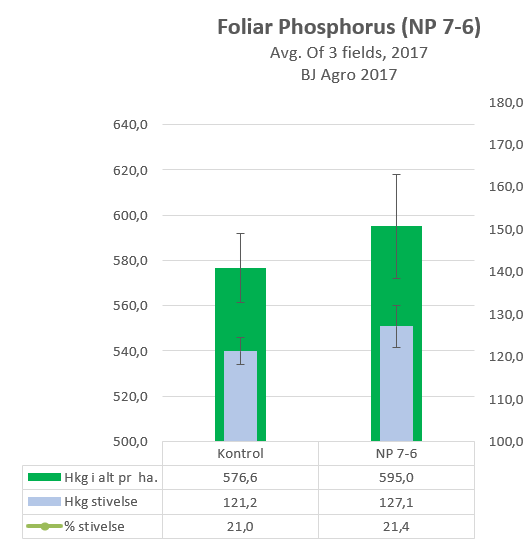 BJ-Agro has found, that by doing regular leaf-analysis, they can spot the need for certain nutrients, particularly nitrogen, phosphorus, potassium, magnesium, boron and other micros.
They have shown again and again, that using this strategy and applying foliar fertilisers to compensate the poor uptake from the dry soil, they can keep the crops growing longer and better, to increase yields, using e.g. Flex Foliar Phosphorus or Flex Foliar Potassium, depending on need.
They have also learned, that the old assumption, that if a crop looks pale and light, it is not always due to nitrogen-deficiency. It may just as well be from phosphorus, potassium or magnesium deficiency.
Other crops
Many other crops have the same needs and issues. In e.g. grass-seed production, we similarly see, that a foliar fertiliser application after flowering tends to give heavier seed, with a better germination.
In Oil-Seed-Rape we can fill up the seeds in the pod, by late-application of fertiliser after flowering.
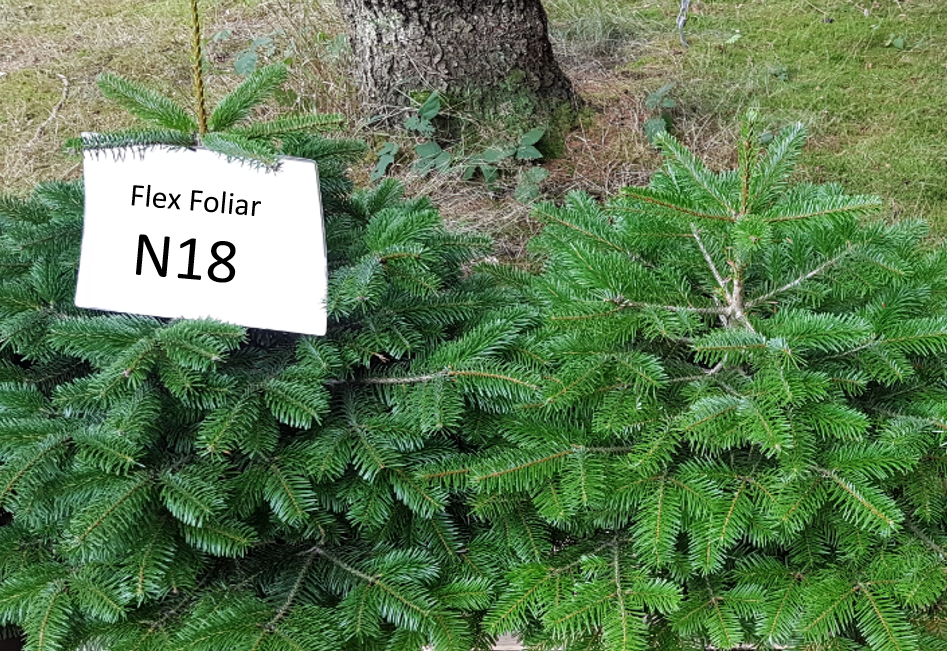 And in crops like Christmas-trees we can improve coloring with late applications of Flex Foliar N18+Mg.
There are many many possibilities to improve your crop yield and quality with foliar fertiliser, you just need to get started to gain the experience. Always remember to start slow and low. Too much on a stressed crop or in combination with fungicides or PGRs may cause some scorch.
If you would like to hear more – and maybe get some more tips for your particular situation, before you start, please do not hesitate to contact us at info@flex.dk – or stop by at the office or one of the fairs we will be attending.

Next up is Borgeby Fältdager in Sweden from June 29-30th.

And then Potato Europe in Germany, Sept 8-9th.
See you in the future!